
Description
30 caps. NEW
This product is only available after consultation with a health-care practitioner. To consult with a practitioner, please call Auckland (09) 826 4482 or use our Contact Form.
For Weight & Metabolic Health.
Description
- Clinically Trialled postbiotic Akkermansia Muciniphila (MucT®).
- Scientifically researched Green Tea
Clinical Benefits
Pasteurised Akkermansia muciniphila MucT® (hereafter referred to as MucT®) is a next-generation postbiotic selected for its ability to reinforce barrier integrity and translate gut-level signalling into clinically relevant metabolic effects [1–3,9]. This is complemented by green tea polyphenols (including epigallocatechin-3-gallate (EGCG)), chromium, riboflavin and vitamin D3, which extend support across glucose metabolism, insulin responsiveness, and immune–barrier regulation [5,6,10–12]. Together, this formulation positions metabolic care to begin where upstream drivers originate: the gut.
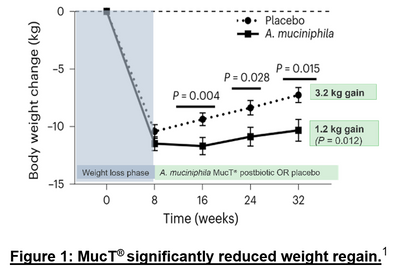
Supports weight maintenance following weight loss MucT®, administered after greater than or equal to 8% diet-induced weight loss in individuals who were overweight or living with obesity, reduced weight regain and supported weight maintenance versus placebo [1]. In this randomised controlled trial, participants completed an 8-week weight loss phase followed by a 24-week maintenance phase with daily MucT® (30 billion colony-forming units (CFU)) or placebo. The MucT® group experienced significantly less weight regain (p=0.012) and greater net weight loss to week 32 (Figure 1) alongside preserved insulin sensitivity and adipose transcriptomic changes consistent with reduced inflammation and enhanced mitochondrial and oxidative function.
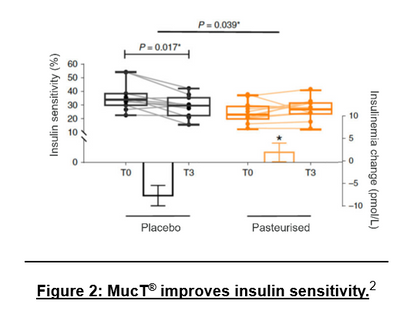
Improves metabolic health: In a randomised, double-blind, placebo-controlled trial in 32 overweight or obese, insulin-resistant adults, 12 weeks of MucT® (10 billion CFU daily) significantly improved multiple metabolic parameters [2]. Insulin sensitivity increased by 28% (Figure 2) and fasting insulin decreased by 34%, alongside a 9% reduction in total cholesterol versus placebo. Plasma lipopolysaccharide (LPS) activity and y-glutamyl transferase (GGT) levels were reduced, indicating improvements in barrier integrity and hepatic function. Dipeptidyl peptidase-IV activity also decreased, suggesting support for inflammatory pathways. White blood cell (WBC) counts, commonly elevated in obesity, were significantly lower in the MucT® group compared with placebo (p=0.037), where levels increased over time. Additionally, serum lactate dehydrogenase (LDH), which has been independently associated with both metabolic syndrome and metabolic dysfunction–associated fatty liver disease (MAFLD), was significantly reduced from baseline (p=0.010) [13]. Favourable trends in body composition were also observed, and the intervention was well tolerated [2].
REFERENCES
[1] Mount S, Canfora EE, Jocken JW, Umanets A, Hul G, Coenjaerds M, et al. Pasteurized Akkermansia muciniphila MucT for weight loss maintenance in people with overweight and obesity: a controlled randomized trial. Nat Med. Published online 2026:1-10. doi:10.1038/s41591-026-04394-7
[2] Depommier C, Everard A, Druart C, Plovier H, Hul MV, Vieira-Silva S, et al. Supplementation with Akkermansia muciniphila in overweight and obese human volunteers: a proof-of-concept exploratory study. Nat Med. 2019;25(7):1096-1103. doi:10.1038/s41591-019-0495-2
[3] Cani PD, Vos WM de. Next-Generation Beneficial Microbes: The Case of Akkermansia muciniphila. Front Microbiol. 2017;8:1765. doi:10.3389/fmicb.2017.01765
[4] Liu Z, Bruijn WJC de, Bruins ME, Vincken JP. Reciprocal Interactions between Epigallocatechin-3-gallate (EGCG) and Human Gut Microbiota In Vitro. J Agric Food Chem. 2020;68(36):9804-9815. doi:10.1021/acs.jafc.0c03587
[5] James A, Wang K, Wang Y. Therapeutic Activity of Green Tea Epigallocatechin-3-Gallate on Metabolic Diseases and Non-Alcoholic Fatty Liver Diseases: The Current Updates. Nutrients. 2023;15(13):3022. doi:10.3390/nu15133022
[6] Wan S, He J, Simoes EJ, Mechanick JI, Wu WC, An P, et al. Chromium Supplementation to Reduce Cardiometabolic Risk Factors A Novel Dose-Response Meta-Analysis of Randomized Clinical Trials. JACC: Adv. 2023;2(10):100729. doi:10.1016/j.jacadv.2023.100729
[7] Asbaghi O, Fatemeh N, Mahnaz RK, Ehsan G, Elham E, Behzad N, et al. Effects of chromium supplementation on glycemic control in patients with type 2 diabetes: a systematic review and meta-analysis of randomized controlled trials. Pharmacol Res. 2020;161:105098. doi:10.1016/j.phrs.2020.105098
[8] Park JE, Park HY, Kim YS, Park M. The Role of Diet, Additives, and Antibiotics in Metabolic Endotoxemia and Chronic Diseases. Metabolites. 2024;14(12):704. doi:10.3390/metabo14120704
[9] Segers A, Vos WM de. Mode of action of Akkermansia muciniphila in the intestinal dialogue: role of extracellular proteins, metabolites and cell envelope components. Microbiome Res Rep. 2023;2(2):6. doi:10.20517/mrr.2023.05
[10] Jeong HW, Kim JK, Kim AY, Cho D, Lee JH, Choi JK, et al. Green Tea Encourages Growth of Akkermansia muciniphila. J Med Food. 2020;23(8):841-851. doi:10.1089/jmf.2019.4662
[11] Wang J, Mei L, Hao Y, Xu Y, Yang Q, Dai Z, et al. Contemporary Perspectives on the Role of Vitamin D in Enhancing Gut Health and Its Implications for Preventing and Managing Intestinal Diseases. Nutrients. 2024;16(14):2352. doi:10.3390/nu16142352
[12] Aragão MÂ, Pires L, Santos-Buelga C, Barros L, Calhelha RC. Revitalising Riboflavin: Unveiling Its Timeless Significance in Human Physiology and Health. Foods. 2024;13(14):2255. doi:10.3390/foods13142255
[13] Yu L, Bao S, Zhu F, Xu Y, Zu F, Liu Y, et al. Serum Lactate Dehydrogenase Is a Novel Predictor for the Severity in the Patients With MAFLD: A Cross-Sectional Study in Hefei, China. Diabetes, Metab Syndr Obes. 2025;18(0):345-361. doi:10.2147/dmso.s492153
Warnings
Vitamins and mineral supplements should not replace a balanced diet.
Not recommended for use by pregnant and lactating women.
In rare cases, Camellia sinensis may harm the liver. Stop use and see a doctor if you have yellowing skin/eyes, or unusual: fatigue, nausea, appetite loss, abdominal pain, dark urine, or itching.
Active Ingredients
Each capsule contains
Akkermansia muciniphila MucT® Postbiotic 30 billion CFU
Riboflavin 2 mg
Chromium picolinate 201 micrograms
Equivalent Chromium 25 micrograms
Chromium chloride hexahydrate 897 micrograms
Equivalent Chromium 175 micrograms
Total equivalent Chromium 200 micrograms
Colecalciferol (Vitamin D3) Equivalent Vitamin D3 200 IU
Camellia sinensis (Green tea), leaf 409 mg
Derived from dry leaf 12 g
Camellia sinensis (Green tea), leaf Equivalent EGCG 225 mg
Free from: Dairy Protein, Lactose, Eggs, Gluten, Wheat, Nuts, Yeast, Soy Protein, Artificial Colours, Artificial Flavors.
Excipients: Microcrystalline cellulose, Silicon dioxide, Magnesium stearate.